There are few things more stressful than hearing a persistent, high-pitched beep while in the middle of a critical production run. I know that sinking feeling when I realize the sound originates from the cooling unit. Understanding the root cause of this disruption is essential for maintaining equipment longevity.
This noise acts as a vital safety mechanism. It alerts me that the system cannot maintain the temperature required to protect the glass tube from thermal stress. Ignoring this CO2 laser water chiller problem can lead to permanent hardware failure and expensive repairs.
I have learned that identifying the source early prevents unnecessary downtime. By following a systematic diagnostic approach, I can resolve the issue quickly and keep my shop running smoothly. This guide explores why is my CO2 laser water chiller alarm going off and provides the steps needed to restore peak performance.
Key Takeaways
- The audible signal serves as a critical safety feature for your equipment.
- Thermal damage to the tube occurs rapidly without proper cooling flow.
- Early detection helps avoid long-term hardware failure and costly production delays.
- Systematic troubleshooting allows for faster resolution of cooling errors.
- Regular maintenance routines significantly reduce the frequency of unexpected system alerts.
Understanding Why Is My CO2 Laser Water Chiller Alarm Going Off
When I hear that sudden, piercing beep from my cooling unit, my first instinct is to identify the source of the trouble. Understanding why is my CO2 laser water chiller alarm going off is essential for protecting my expensive laser tube from permanent damage. These devices are designed to act as a fail-safe, meaning they prioritize the health of my machine over continuous operation.
I have learned that these alarms are rarely random. They usually indicate a specific breakdown in the cooling loop that requires my immediate attention. By analyzing the internal logic of my equipment, I can quickly distinguish between a minor sensor glitch and a serious mechanical failure.
Common Alarm Triggers in CW-5000 and CW-5200 Series
The CW-5000 and CW-5200 series are industry standards, yet they share common vulnerabilities that often trigger a CO2 laser chiller alarm. Most frequently, the system detects an abnormal water temperature or a sudden drop in flow rate. If the water temperature exceeds the set limit, the controller triggers an alert to prevent the laser tube from overheating.
Another common trigger involves the electrical stability of the unit. If the power supply fluctuates or the internal controller fails to receive a signal from the sensors, the system defaults to a safe, locked state. I find it helpful to keep a log of these events to see if they correlate with high ambient temperatures in my workshop.
| Alarm Trigger | Primary Cause | System Response |
|---|---|---|
| High Temperature | Cooling capacity exceeded | Alarm sounds, laser cuts off |
| Low Flow Rate | Blockage or pump failure | Alarm sounds, signal interrupted |
| Sensor Error | Loose wiring or defect | Display shows error code |
| Power Fluctuation | Unstable voltage supply | System reset or shutdown |
The Role of the Flow Switch in System Safety
The flow switch acts as the critical gatekeeper of my entire laser setup. It monitors the movement of water through the tube and sends a continuous signal to the laser power supply. If the water circulation drops below a safe threshold, the switch opens the circuit, effectively cutting off the laser signal.
This mechanism is vital because even a few seconds of operation without proper cooling can lead to catastrophic failure of the laser tube. I treat every alarm as a genuine warning rather than a nuisance. By respecting the role of the flow switch, I ensure that my equipment remains operational for years to come.
Initial Safety Checks and System Inspection
Safety is the foundation of effective CO2 laser chiller alarm troubleshooting. Before I attempt any technical repairs, I must prioritize my personal safety and the protection of my equipment. I always start by fully powering down the laser system to prevent accidental activation during my inspection.
Powering Down and Disconnecting the Laser System
I make it a habit to unplug the chiller from the power source entirely. This simple action eliminates the risk of electrical shock while I work on the internal components. Never assume the system is safe just because the display is off. Always verify that the power cable is physically removed from the wall outlet or the power strip.
Once the power is disconnected, I wait a few minutes for any residual charge to dissipate. This pause allows me to approach the CO2 laser water chiller problem with a clear head. I ensure that the laser machine itself is also powered down to maintain a stable environment for my diagnostic work.
Visual Inspection of Tubing and Connections
After securing the power, I begin a systematic visual inspection of the entire cooling loop. I look for external leaks, loose fittings, or signs of wear on the silicone tubing. This proactive step often reveals simple issues, such as a disconnected hose or a kinked line, that are easily corrected without complex tools.
I pay close attention to the points where the tubing connects to the laser tube and the chiller unit. Even a small crack in the hose can lead to a significant CO2 laser water chiller problem if left unaddressed. The following table outlines the key areas I check during my routine inspection.
| Inspection Point | Common Issue | Action Required |
|---|---|---|
| Silicone Tubing | Kinks or cracks | Straighten or replace |
| Hose Clamps | Loose connections | Tighten securely |
| Water Reservoir | Low fluid level | Refill with distilled water |
| External Fittings | Visible moisture | Dry and reseal |
Ensuring the integrity of the cooling loop is the first step in my CO2 laser chiller alarm troubleshooting journey. By catching these physical faults early, I often avoid the need for more invasive repairs. I always document my findings to keep track of the system’s health over time.
Troubleshooting Flow Rate and Water Circulation Issues
Mechanical flow issues are the most common culprits behind a persistent chiller alarm. When the internal sensor fails to detect steady movement, it triggers a safety shutdown to protect your laser tube from overheating. Effective troubleshooting CO2 laser chiller alarm conditions requires a systematic look at the entire water path.
Identifying Air Bubbles in the Cooling Loop
Air pockets are notorious for tricking the flow sensor into reporting a circulation failure. Even a small amount of trapped air can disrupt the turbine inside the sensor, causing it to stop spinning momentarily.
To fix this, I recommend tilting the chiller slightly while it is running to help the air move toward the reservoir. You should also ensure that your return line is submerged properly to prevent new air from entering the loop.
Checking for Kinks or Blockages in Water Lines
Physical obstructions are frequent sources of CO2 laser water chiller issues. I always inspect the tubing for sharp bends or kinks that might restrict the flow of coolant to the laser head.
If the water appears cloudy or contains debris, it may be clogging the internal filter or the laser tube inlet. Replacing the water and flushing the lines often resolves these flow restrictions immediately.
Verifying Pump Performance and Impeller Functionality
The pump is the heart of your cooling system, and its failure will inevitably lead to an alarm. If the pump is not pushing water with enough pressure, the flow sensor will remain inactive regardless of the water level.
I suggest checking the pump intake for any buildup of algae or mineral deposits. A clean impeller is essential for maintaining the consistent pressure required by your laser system.
Testing the Pump for Unusual Noise or Vibration
When performing CO2 laser chiller alarm troubleshooting, listen closely to the pump during operation. A healthy pump should produce a steady, low-frequency hum.
If you hear grinding, rattling, or high-pitched squealing, the impeller may be damaged or the bearings could be failing. Excessive vibration is a clear sign that the pump needs immediate maintenance or replacement to avoid a total system failure.
| Symptom | Likely Cause | Recommended Action |
|---|---|---|
| Intermittent Alarm | Trapped Air Bubbles | Tilt unit to bleed air |
| Low Flow Rate | Kinked Tubing | Straighten or replace lines |
| Grinding Noise | Worn Impeller | Inspect and replace pump |
| No Water Movement | Clogged Filter | Clean or replace filter |
Addressing Temperature Sensor and Cooling Capacity Problems
When your chiller struggles to keep cool, environmental factors are often to blame. I frequently encounter CO2 laser water chiller issues that stem from a simple mismatch between the machine’s settings and its surroundings. Proper thermal management is essential to ensure your laser tube operates within safe parameters.
Calibrating the Temperature Controller Settings
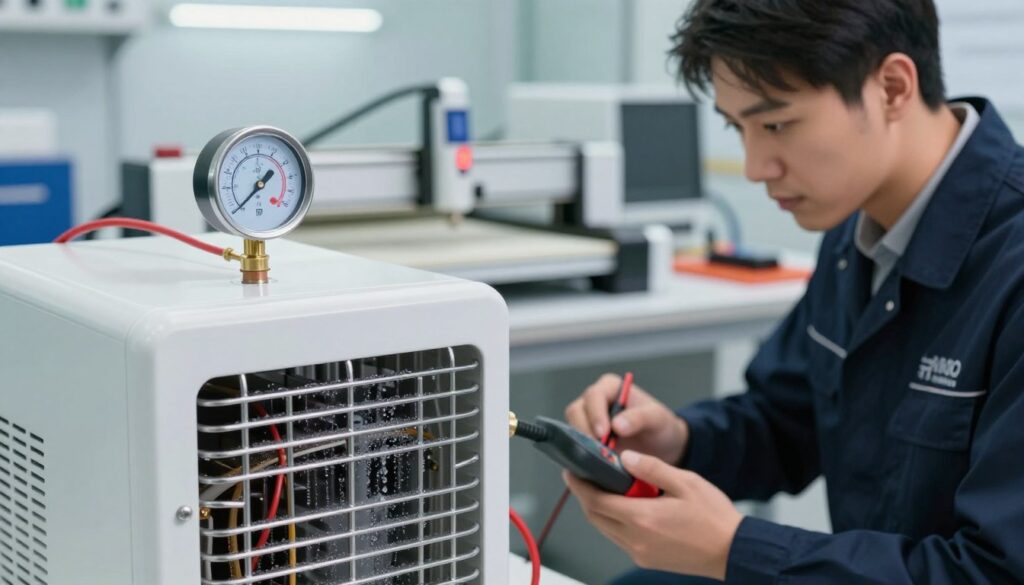
If the digital display shows a temperature that does not match the actual water temperature, you likely need to recalibrate the controller. I recommend using a separate, high-quality thermometer to verify the water temperature manually. Once you confirm the variance, you can adjust the offset settings in the controller menu to align the sensor reading with reality.
Cleaning the Dust Filter and Condenser Coils
Neglecting the physical maintenance of your cooling unit is a common mistake. Over time, dust and debris build up on the intake filters and the condenser coils, which severely restricts airflow. You should regularly inspect and clean these components to maintain optimal heat exchange efficiency and find effective CO2 laser chiller alarm solutions.
Why Dust Accumulation Causes Overheating Alarms
Dust acts as an insulator, preventing the condenser from releasing heat into the room. When the heat cannot escape, the internal water temperature rises rapidly, forcing the system to trigger an overheating alarm. Keeping these surfaces clean is the most straightforward way to prevent these nuisance alerts.
Verifying Ambient Temperature Requirements
Your chiller is designed to operate within a specific ambient temperature range, typically between 68°F and 77°F. If your workshop exceeds these limits, the chiller will struggle to dissipate heat, regardless of how clean the filters are. I suggest monitoring your room temperature closely to ensure you are implementing the best CO2 laser chiller alarm solutions for your specific environment.
Resolving Electrical and Controller Alarm Triggers
Sometimes, the root cause of a persistent alert is not a physical blockage but an internal electrical fault. Troubleshooting CO2 laser chiller alarm issues often requires moving beyond the plumbing to examine the internal wiring and digital controls. When physical checks fail to resolve your cooling issues, it is time to investigate the electronic components that manage your system’s safety signals.
Checking Wiring Connections for Loose Terminals
Vibrations from the pump or cooling fan can occasionally cause internal wire terminals to loosen over time. I recommend powering down the unit and carefully inspecting the control board for any disconnected or frayed wires. Securing these connections often restores the signal path and eliminates false alarms caused by intermittent contact.
Interpreting Error Codes on the Digital Display
Your chiller’s digital controller is designed to communicate specific faults through alphanumeric codes. These codes are essential CO2 laser chiller alarm solutions because they point directly to the failing component, such as a faulty temperature probe or a communication error. Always consult your user manual to decode these messages, as they provide the most accurate diagnostic data available.
Testing the Flow Sensor Signal Continuity
If the wiring appears intact, the flow sensor itself might have reached the end of its service life. You can verify this by using a multimeter to test the sensor for electrical continuity while the pump is active. If the sensor fails to complete the circuit despite proper water movement, it is likely time to replace the part to ensure your laser remains protected.
Performing a Proper CO2 Laser Chiller Alarm Reset
After fixing the underlying problem, I must perform a proper reset to restore normal system operation. Simply clearing the physical fault is often not enough, as the controller may retain the error state in its memory. Successfully managing a CO2 laser chiller alarm requires a systematic approach to ensure the unit recognizes that the cooling loop is safe to operate again.
Step-by-Step Reset Procedure for Standard Controllers
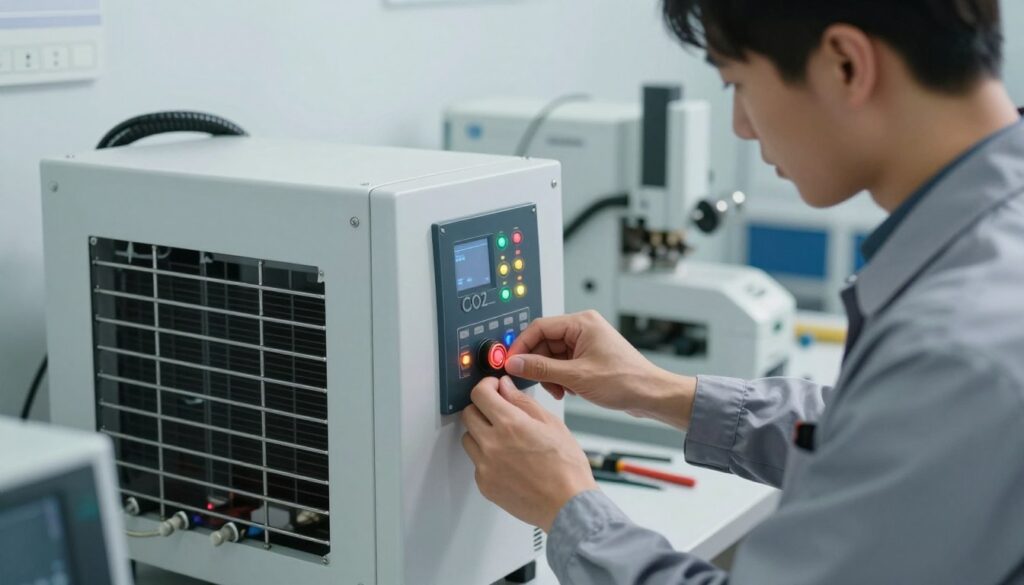
Most standard industrial chillers utilize a digital controller that requires a specific sequence to clear active alerts. Once I have verified that the water flow is restored and the temperature is within the safe range, I follow these steps to perform a CO2 laser chiller alarm reset:
- Locate the “Set” or “Alarm” button on the front panel of the controller.
- Press and hold the designated reset button for approximately three to five seconds.
- Observe the digital display to see if the flashing error code disappears or returns to the current temperature reading.
- If the alarm persists, I verify that the flow switch is not stuck and that the water level is sufficient before attempting the sequence again.
When to Perform a Hard Power Cycle
Sometimes, the digital controller becomes unresponsive or continues to display a false error code despite my best efforts. In these instances, a hard power cycle is the most effective way to clear the internal memory of the device. I perform this action only after I am certain that the mechanical issue causing the CO2 laser chiller alarm has been fully resolved.
To execute a hard power cycle, I switch off the main power supply and unplug the unit from the wall outlet. I wait for at least sixty seconds to allow the capacitors in the controller to discharge completely. After this waiting period, I plug the unit back in and restart it, which usually completes the CO2 laser chiller alarm reset process and allows me to resume my laser work with confidence.
Preventive Maintenance to Avoid Future Chiller Downtime
I have learned that consistent care is the best strategy for maintaining a reliable and long-lasting laser cooling system. By staying ahead of potential hardware failures, I can avoid the constant need for a CO2 laser chiller alarm reset. Proactive maintenance ensures that my equipment remains operational during critical production hours.
Establishing a Regular Water Change Schedule
Water quality is the foundation of a healthy cooling loop. Over time, water loses its thermal efficiency and begins to accumulate debris. I make it a priority to drain and replace the water in my system every three to four weeks to prevent mineral buildup that can trigger a CO2 laser chiller alarm reset.
Using Distilled Water and Algaecide Additives
I strictly use distilled water to fill my chiller reservoir. Tap water contains minerals and impurities that eventually lead to scale deposits on internal components. Furthermore, I always add a high-quality algaecide to the mixture. This simple step prevents biological growth, which is a common culprit for clogging sensors and restricting pump flow.
Monitoring Chiller Performance During Peak Usage
I keep a close eye on my chiller during high-intensity work sessions. By observing the temperature stability and flow rate during peak usage, I can identify subtle performance drops before they escalate into full system shutdowns. This vigilance allows me to perform minor adjustments rather than dealing with an emergency CO2 laser chiller alarm reset.
| Maintenance Task | Frequency | Purpose |
|---|---|---|
| Water Replacement | Monthly | Prevent mineral buildup |
| Algaecide Addition | Every 3 Months | Stop biological growth |
| Filter Cleaning | Bi-Weekly | Ensure airflow efficiency |
| System Inspection | Weekly | Check for leaks or kinks |
Conclusion
Reliable operation of a CO2 laser depends on a healthy cooling loop. Most chiller alarms are preventable through consistent maintenance and careful monitoring of the S&A CW-5000 or CW-5200 units.
I now understand that proactive care keeps my equipment running at peak performance. By following these troubleshooting steps, I can quickly identify whether the issue stems from flow, temperature, or electrical components.
Taking the time to perform these checks ensures that my laser system remains safe and productive for all my projects. I feel confident in my ability to resolve common chiller problems and minimize future downtime.
Do you have a specific tip for maintaining your water chiller? Share your experiences with the community to help others keep their laser cutters in top shape. Your insights contribute to a better understanding of these essential cooling systems.