Achieving professional results on delicate jewelry requires precision tools that hold circular items firmly in place. In my experience, selecting the right hardware is the most critical step for anyone serious about metal marking. I have spent years testing various setups to find the best rotary chuck attachment for engraving ring bands that ensures consistent quality.
Many standard market alternatives fail to provide the stability needed for intricate designs. By following my proven workflow, you will learn how to identify specific features that distinguish high-quality gear from basic models. Mastering these technical nuances will elevate your projects to a professional standard quickly.
Key Takeaways
- Precision hardware is essential for marking delicate jewelry pieces.
- Stability prevents slippage during the marking process on circular items.
- High-quality gear features adjustable grips for various sizes.
- Understanding technical specifications helps avoid common equipment failures.
- Professional results depend on choosing the right tool for your specific machine.
Understanding the Mechanics of Ring Band Engraving
When I first started engraving jewelry, I quickly realized that the secret to perfect results lies in the mechanics of the rotary system. Transitioning from flat-surface marking to 360-degree ring band engraving is a technical journey that begins with understanding how your hardware maintains focus on curved surfaces.
Why a Rotary Chuck Attachment is Essential for Jewelry
A rotary chuck attachment is the gold standard for precision work because it provides a mechanical grip that rollers simply cannot match. When you place a thin, precious metal band on a roller, it often slips or wobbles during the rotation. This movement ruins the laser focus and leads to distorted designs.
“Precision in jewelry engraving is not just about the laser; it is about the mechanical stability provided by your rotary attachment.”
By using a chuck-based system, I can secure the ring firmly in place. This ensures that the distance between the laser head and the metal surface remains constant throughout the entire 360-degree rotation. This consistency is vital for achieving crisp, professional results on delicate items.
Key Differences Between Roller Rotaries and Chuck Rotaries
Choosing the right engraving tool depends on the specific geometry of your project. While roller systems are excellent for large, cylindrical objects like tumblers, they lack the grip required for small-diameter jewelry. The following table highlights the primary differences between these two systems.
| Feature | Roller Rotary | Chuck Rotary |
|---|---|---|
| Primary Use | Large Cylinders | Small Ring Bands |
| Stability | Moderate | High |
| Clamping Method | Friction-based | Mechanical Jaws |
| Precision | Standard | Professional |
Compatibility Requirements for Your Laser Engraving Machine
Before you invest in a new system, you must ensure your jewelry engraving machine is fully compatible. Most modern setups require a specific stepper motor voltage to communicate effectively with the rotary axis. I always recommend checking your controller board for a dedicated 4-pin aviation port.
Seamless integration also depends on your software configuration. You need to verify that your laser software can handle the pulse-per-rotation settings required for the rotary chuck attachment. Without proper calibration, your ring band engraving will suffer from scaling errors, making the final design appear stretched or compressed.
Selecting the Best Rotary Chuck Attachment for Engraving y भी Ring Bands
Selecting the best rotary chuck attachment for engraving y भी ring bands requires a careful look at build quality and precision. As a professional, I know that the right hardware determines the difference between a masterpiece and a ruined piece of jewelry. You must evaluate how each tool handles the unique geometry of circular bands.
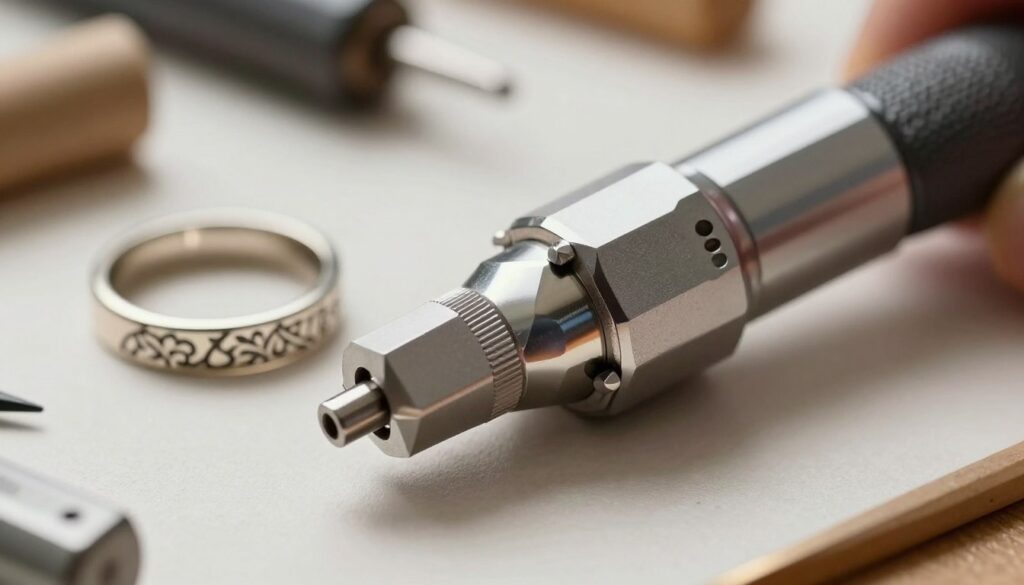
Evaluating the xTool RA2 Pro for Precision Jewelry Work
The xTool RA2 Pro stands out as a highly versatile jewelry engraving tool. I find its ability to switch between different modes makes it ideal for creators who handle diverse projects. Its precision is unmatched when working with delicate materials like gold or silver.
“Precision is not just a goal; it is the foundation of every successful engraving project.”
Analyzing the OMTech 3-Jaw Chuck Rotary for Stability
If your focus is on heavy-duty production, the OMTech 3-Jaw Chuck Rotary offers incredible stability. This rotary chuck attachment is built to last, providing a firm grip that prevents slippage during the rotation process. It is a reliable workhorse for any workshop environment.
| Feature | xTool RA2 Pro | OMTech 3-Jaw |
|---|---|---|
| Primary Use | Intricate Jewelry | General Production |
| Stability | High | Very High |
| Versatility | Excellent | Good |
Features to Prioritize for Small Diameter Ring Engraving
When shopping for a ring band engraving solution, you must prioritize specific mechanical features. Always look for self-centering jaws, which ensure your design remains perfectly aligned throughout the entire 360-degree rotation. A low-profile design is also essential to maintain clearance within your laser bed.
Furthermore, ensure your chosen jewelry engraving tool can securely clamp small diameters without causing deformation. Proper tension control is vital for successful ring band engraving. Investing in a high-quality rotary chuck attachment will save you time and material costs in the long run.
Setting Up Your Rotary Chuck for Optimal Results
I have found that the difference between a ruined ring and a masterpiece lies entirely in the initial calibration of your equipment. When you use a rotary chuck attachment, you must ensure that every mechanical component is perfectly synced with your laser system. Taking the time to prepare your workspace prevents costly mistakes and protects your precious metal materials from accidental surface deformation.
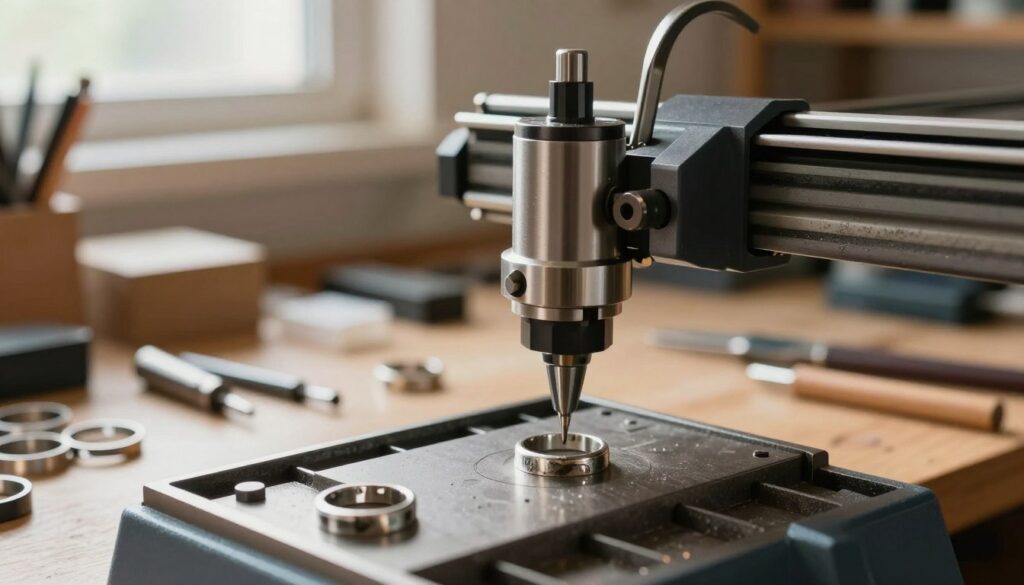
Calibrating the Chuck Jaws for Different Ring Sizes
The primary goal when using a rotary tool attachment is to secure the ring without applying excessive pressure. I recommend adjusting the chuck jaws slowly to match the inner diameter of the band. Tighten the jaws just enough to prevent slippage during the rotation process, as over-tightening can easily warp delicate gold or silver.
Always verify that the ring sits perfectly centered within the jaws. If the band is off-center, your design will appear distorted or blurry on one side. Using a digital caliper to measure the ring diameter before mounting it helps maintain consistent pressure across different projects.
Ensuring Proper Leveling and Alignment on the Laser Bed
Leveling your rotary engraver relative to the laser head is critical for maintaining a uniform focal distance. If the device is tilted, the laser beam will lose focus as it travels across the circumference of the ring. I suggest using a small spirit level to confirm that the axis is perfectly parallel to the laser bed.
Proper alignment ensures that the engraving depth remains constant throughout the entire design. Even a slight deviation can lead to uneven marks that ruin the aesthetic quality of the jewelry. Consistency is the hallmark of professional work, so never skip this verification step.
Connecting and Configuring the Rotary Axis in LightBurn
Once the hardware is physically secure, you must configure the software to translate your design files into accurate rotational movements. Within LightBurn, navigate to the rotary setup menu to define your specific rotary tool attachment parameters. You will need to input the correct steps per rotation to ensure the software knows exactly how far to turn the ring for each pass.
Testing the movement with a scrap piece of metal is a smart way to verify your settings before committing to a final piece. This final check confirms that your rotary engraver is ready for production. Refer to the following table for a quick summary of essential setup variables to monitor during your workflow.
| Parameter | Importance | Recommended Action |
|---|---|---|
| Jaw Pressure | Prevents slippage | Use light, firm grip |
| Axis Leveling | Maintains focus | Check with spirit level |
| Steps per Rotation | Ensures accuracy | Calibrate in LightBurn |
| Center Alignment | Prevents distortion | Verify with calipers |
Executing the Engraving Process on Precious Metals
I have found that the secret to perfect jewelry engraving lies in the preparation of the surface before the laser fires. Achieving professional results on precious metals requires a disciplined approach to every step of the process. When you use a high-quality jewelry engraving tool, the difference in the final output becomes immediately apparent.
Preparing the Ring Surface for Consistent Laser Interaction
Before you begin, you must ensure the metal is free of oils and debris. I always wipe the ring down with high-purity isopropyl alcohol to guarantee a clean canvas. If you skip this step, the laser may interact unevenly with the surface, leading to patchy marks.
Applying a thin layer of laser marking spray or masking tape is often necessary to prevent unwanted oxidation. This protective barrier allows your rotary tool attachment to focus energy precisely where it is needed. Consistency is the key to ensuring that your design appears crisp and uniform across the entire circumference of the band.
Determining Optimal Power and Speed Settings for Gold and Silver
Precious metals are highly reflective, which makes them challenging to mark. I recommend starting with low power and high speed to test the reaction of the material. You can gradually increase the intensity until you achieve the desired depth without burning the metal.
For gold, I prefer a slower speed to allow the laser to etch deeply without causing excessive heat buildup. Silver often requires a slightly higher power setting due to its high thermal conductivity. Using the right engraving tool settings will prevent the metal from warping or discoloring during the sequence.
Troubleshooting Common Issues During the Engraving Sequence
Even with the best setup, you might encounter minor hurdles during the process. Rotational drift is a common issue that occurs when the ring is not perfectly centered on the rotary tool attachment. If you notice the design shifting, stop the machine immediately and re-check your jaw tension.
Inconsistent depth usually points to an uneven surface or a focal length error. Always verify that your laser head is perfectly perpendicular to the ring surface before starting. By maintaining a jewelry engraving tool that is properly calibrated, you can avoid these frustrations and produce stunning, professional-grade results every time.
Conclusion
Mastering the use of a rotary chuck attachment transforms the way you approach custom jewelry design. This skill unlocks new creative paths for your jewelry engraving machine by allowing for intricate, wrap-around patterns on delicate bands.
I find that the transition from flat surface marking to cylindrical work requires patience and a sharp eye for detail. Every successful project builds your confidence in handling precious metals with your rotary engraver.
You should view each ring as a unique canvas for your artistic vision. Experimenting with different speed and power settings helps you understand the specific needs of gold, silver, and platinum.
My best advice is to keep a log of your successful settings for future reference. This habit turns your jewelry engraving machine into a reliable partner for high-end production work.
I encourage you to push the boundaries of your rotary engraver as you gain experience. Your commitment to mechanical precision will set your work apart in a competitive market. Share your latest designs with your community to inspire others who are just starting their journey into laser customization.